~ Aeolian and Aegadian Islands 14 Day Route Sailing Holidays in Sicily
|
From |
To |
Nautical Miles |
|
Palermo |
Cefalu |
31nm |
|
Caefalu |
Vulcano |
60nm |
|
Vulcano |
Pananrea |
8nm |
|
Pananrea |
Stromboli |
12nm |
|
Stromboli |
Salina |
21nm |
|
Salina |
Fillicudi |
14nm |
|
Fillicudi |
Alicudi |
8nm |
|
Alicudi |
Isola delle Femmine |
56nm |
|
Isola delle Femmine |
Levanzo |
50nm |
|
Levanzo |
Marettimo |
17nm |
|
Marettimo |
Favignana |
15nm |
|
Favignana |
San Vito lo Capo |
25nm |
|
San Vito lo Capo |
Palermo |
47nm |
Cefalu
Set in the medieval district, Cefalù's most obvious tourist attraction is the town's Duomo, an attractive two-towered Norman cathedral. Begun in 1131, this mighty church dominates the town's rooftops. Imposing and attractive, the building's interior is decorated with lovely mosaics dating back to 1138: a large Christ Pantocrator on a gold background dominating the apse, above the Madonna, archangels and Apostles.Towering above the Duomo and the town centre is the massive crag called the Rocca. It's a steep climb to the top of the mountain (take a bottle of water and don't attempt in high temperatures) but it's well worth the effort. Near the top you'll reach the splendid ruins of the 'Tempio di Diana' (Temple of Diana)' an ancient megalithic stone structure which was given a modernisation in the 5th-century BC in the classical Greek style. Around the summit of the Rocca are superb views and various bits of old fortifications, including a stretch of (reconstructed) battlements.
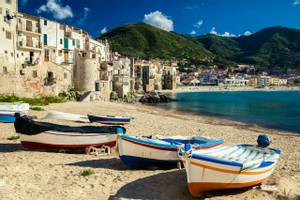
Many tourists are also attracted by Cefalù's sandy beach, stretching alongside the town. Look out in peak season though, as this beach can be quite crowded with scantily clad Italians.
Vulcano
It was once called 'Hierà" (the sacred), but also "Termessa" or "Terrasia". Today it is famous for the baths in the warm waters of its submarine springs. This 21 sq km, 500 metre high (Monte Aria) isle is the Aeolian island closest to the Sicilian coast.Its name is a clear description of its geography: a land of lava and fumarole, yellow sulphur rocks and black sands all worth a visit. There are three volcanoes on the island: the first dormant since the prehistoric age; the second is Vulcanello (123 metres high and dormant since 183 B.C.); the last is Fossa di Vulcano (only the fumaroles are still active).
Panarea
The ancient island of "Euonimo" is predominantly focussed on luxury tourism. The main village, Contrada San Pietro, consists of a picturesque group of white houses clustered along the eastern side of the island. The built-up area is crowned with olive trees and protected by huge walls.The other two villages north and south of San Pietro are Dittella and Drauto. The only practical roads on the island join the centre with Punta Calcara: a kingdom of fumaroles (emissions of hot gas and steam) and is situated at the northern tip of the island. The temperature of the soil can reach as high as 100 degrees.
In the exact opposite corner (the south-eastern tip of the island) lies the prehistoric village of Punta Milazzese (a hut-village dating back to the Bronze Age), which can be reached from the beach of San Pietro in an hours walk. We recommend sailing to the nearby small islands of Basiluzzo, Dattilo and Lisca Bianca, to the Scoglio Bottaro (with its underwater "fumaroles"), and to the crags Lisca Nera, Panarelli and Le Formiche. Fields of golden corn cover the 420-metre-high peak of Pizzo del Corvo (the island's highest point) while the mountain slopes down towards the sea on the eastern side.
Stromboli
This 924 metre high lava mountain (Serra Vancori) which drops abruptly down to 2000 metres below sea-level is Europe's biggest active volcano after Etna. Its area of 12.6 sq km is visually dominated by the crater: a sort of suggestive natural lighthouse situated in the easternmost Aeolian island.During the night, the glittering "sciara" of fire (the red-hot flow descending towards the sea) can be seen from the sea and from Panarea. During the day, the smoke of the peak joins the steam raising up from the water that cools down the red-hot lava detritus which have plunged into the water after sliding down the slope of the coast. The white houses of the little village create a unique contrast with the black lava background dotted with dark-green bushes.
Salina
This isle is the second largest Aeolian island. It was named after the little salted lake of Lingua lying at the south-eastern tip of Salma where the inhabitants once gathered the salt needed to preserve capers and fish. This centrally located isle, lying two miles from Lipari, is the only Aeolian island with land suitable for agriculture thanks to its many water sources. More than 400 types of plants grow here.It is also the island with the highest peaks such as the three volcanoes that originated it: Monte Fossa delle Felci (962 m), which is partially covered by one of the most beautiful strawberry tree woods of the entire Mediterranean; Monte dei Porri (860 m); and Monte Rivi (850 m).
Besides the three villages of Santa Marina Salma (the biggest), Malfa and Leni there are also five hamlets: Lingua, Rinella, Valdichiesa, Pollara and Torricella. Salma, too, can take pride in its past during the Bronze Age, which is demonstrated by a grave, found in Malfa, dating back to the third millennium B.C. The remains are exhibited in the Museum of Lipari.
Filicudi
Once it was called 'Phoenicusa' which translates from Italian to mean "rich in ferns” and a major area of the island is still covered with this type of vegetation. It is the most ragged of this group of islands and geologists believe that its formation is the product of six eruptive mouths, three of which represent today's peaks of the island: Fossa delle Felci (774 m) which is the oldest; Montagnola (333 m) which is probably the most recent; and Torrione (280 m).This quiet holiday island, light-years away from traffic and noise has two villages lying on a small peninsula stretching out towards the south: Filicudi Porto and Pecorini a Mare. The remains of prehistoric settlements from the Bronze Age have been found here. Excavations have also been carried out in the upper area and up to the peak of the Montagnola. Subsequent settlements were built here, probably for defence requirements and deserve a visit. The island's only usable road is a mule-path.
Alicudi
Alicudi is known as the ‘Island of Heather’ due to the pink blanket that covers its lavic surface in spring. This island (5.2 sq km) once called "Ericusa" is an extinct volcano that rises out of the sea to reach the summit of Monte Filo dell'Arpa (657m; known as Timpone della Montagnola).This is the smallest and western-most of the inhabited Aeolian islands and lies about 67 miles from Milazzo. It is not part of the mass tourism circuit and the only landing area is near the Scoglio della Palomba. Tourist accommodation for example, is only possible in boarding-houses and private homes. Near the village there is a rise called "Timpone delle femmine' where women used to be hidden in this almost impenetrable location to prevent them from being kidnapped by the pirates during their raids.
A sail along the 4kms of the island's coast reveals enchanting spots and peculiar red and black rocks that partition small beaches from each other. The completely uninhabited western side of the island shows particularly spectacular walls falling into the water. The stair-shaped eastern side is populated however, and you can see the church of San Bartolomeo rising above the houses of Alicudi and offering a wide
Isola delle Femmine
Isola delle Femmine is a popular destination for tourists and locals alike, with a wonderful sandy beach and relics of history dotted around the town, it sweeps you away to another time. The Chiesa di Santa Maria delle Grazie built in the 1700’s amongst other classical buildings, is a great place to visit and take in the spectacular architecture.Levanzo
Levanzo is an island that is somewhat deceiving with its towering hills overlooking the sea, it belies how small Levanzo actually is. A tranquil haven for nature lovers and explorers with one road to take you form north to south, it’s definitely off the beaten track. On the south side of the island you’ll find the clearest water, in the bay of Cala Dogana which is Levnazo’s only hamlet. With a rugged landscape, Pizzo die Monaco’s rocky skirts disappearing into the sea, azure water and white washed buildings Levanzo can’t fail to charm you.Marettimo
Marettimo is a pleasure, simply and utterly a pleasure. One of the more remote Aegadian Islands with its limestone cliffs dropping into the sea it makes for an impressive backdrop against the colour of the sea. The harbour at Marettimo is cosy and welcoming amongst the white houses that surround the harbour. To one side of the harbour you’ll see the ruins of a Spanish 17th Century castle atop Punto Troia, which served as a prison until 1844.Around the island there are spectacular natural caves, for which the local fisherman love to show the visitors who make it to Marettimo, one of the caves Grotta del Cammello is wonderful with a little pebble beach inside.
Favignana
Favignana is sometimes referred to as ‘La Farfalla’, as its shape is a kin to a butterfly fluttering across the sea. One of the larger Aegadian Islands, Favignana still has the warmth and character you’d expect from Sicily. Favignana città has two main piazzas - Piazza Europa and Piazza Madrice which are linked by the main street, where people watching, enjoying a coffee or an ice cream is very much the done thing. As with other regions, fishing is one of the main trades of the island and you’ll find local restaurants serving traditional dishes.San Vito lo Capo
San Vito lo Capo is a bubbling town, with delights to entertain even the most discerning traveller. With a great and wide sandy beach to relax on, enough pizzerias to feed a Roman legion and the charm of Sicily you can’t go wrong. In September every year there is the ‘Festival of Couscous’ where chefs from Egypt to Tunisia come to take part, and if you’re lucky enough to be there you’ll get to taste it to.- Make an Enquiry
- Availability & Pricing
- Order a Brochure
- 020 8438 1133